


Table of Contents
The 2026 Guide to Studying in the UK: Courses, Careers, and the New Path to PR
The landscape for international students in the UK has shifted significantly as we move through 2026. With the government’s focus on high-skill migration and “earned settlement,” planning your journey from a student visa to Permanent Residency (PR) requires more strategy than ever before.
If you are planning your intake for late 2026 or 2027, here is the updated roadmap you need to know.
1. What’s New in 2026? (The Major Updates)
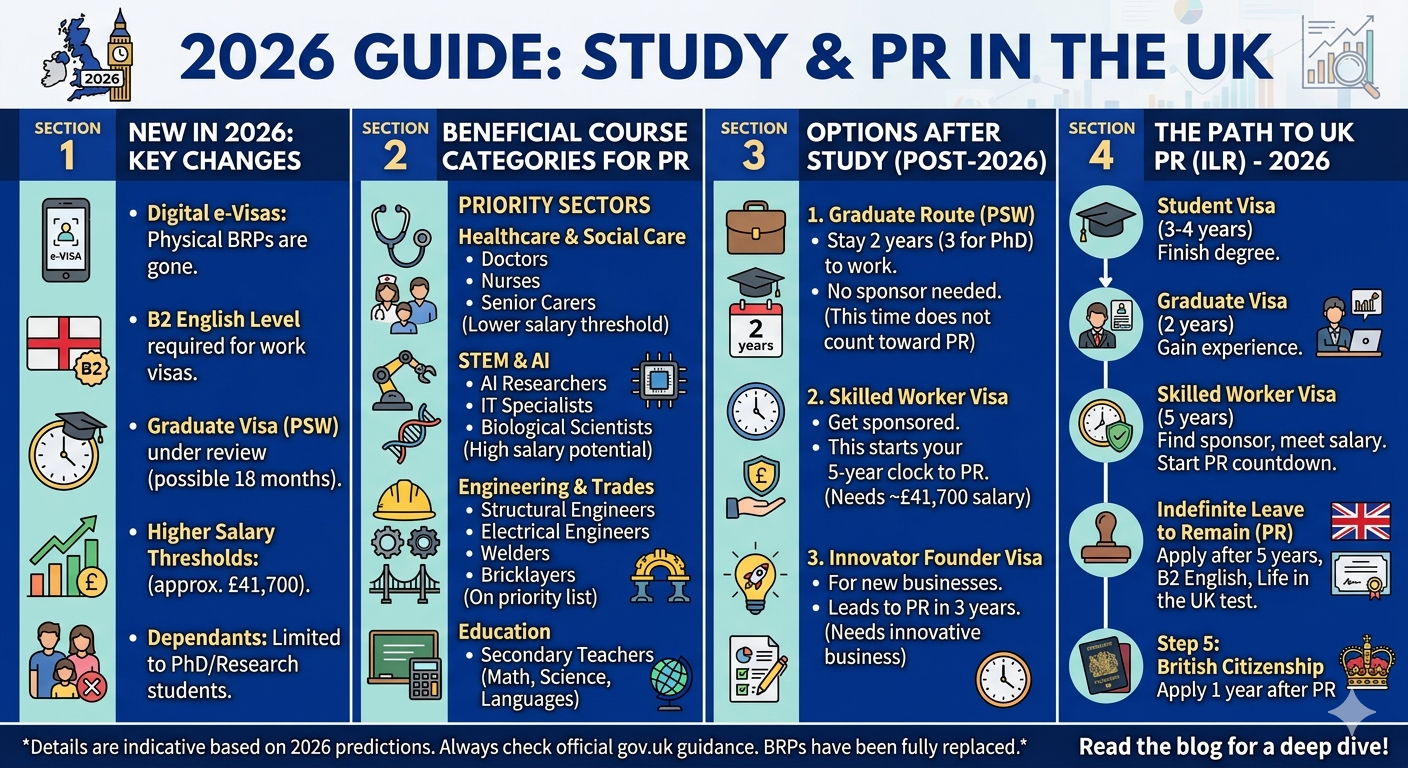
The rules have tightened since the 2025 Immigration White Paper. Key changes include:
-
Higher English Standards: As of January 8, 2026, the English requirement for switching to a Skilled Worker or High Potential Individual (HPI) visa has increased from B1 to B2 level (Upper Intermediate).
-
The “10-Year Rule” Consultation: There is a significant move toward an “Earned Settlement” model. While the 5-year route still exists for high earners, the standard qualifying period for Indefinite Leave to Remain (ILR) is being discussed for extension to 10 years for many categories.
-
Graduate Visa Ticking Clock: If you apply for a Graduate Visa after January 1, 2027, the duration will drop from 24 months to 18 months for Master’s and Bachelor’s graduates. 2026 graduates are the last to reliably secure the full 2-year window.
-
Fee Hikes: As of April 8, 2026, visa and settlement fees have risen by 6–7%. Applying for ILR now costs over £3,200 per person.
2. Most Beneficial Courses for PR in 2026
To get PR, you must transition to a Skilled Worker Visa. The best courses are those that lead to roles on the Immigration Salary List (ISL) or high-paying sectors that meet the £41,700 minimum salary threshold.
A. Healthcare & Life Sciences
The NHS remains the UK’s largest employer with the most stable sponsorship track.
-
Top Courses: Nursing, Social Work (Senior levels), Biomedical Science, and Psychology.
-
PR Benefit: These roles often have lower salary thresholds and lower visa application fees (Health and Care Worker Visa).
B. AI, Data Science & Green Tech
The UK is aggressively recruiting for its “Green Industrial Revolution” and AI sector.
-
Top Courses: Artificial Intelligence, Renewable Energy Engineering, Cyber Security, and Data Analytics.
-
PR Benefit: Salaries in these sectors typically start well above the £41,700 floor, making sponsorship easier to justify for employers.
C. Specialized Engineering & Construction
With massive infrastructure projects underway, specialized engineering is in high demand.
-
Top Courses: Civil Engineering, Quantity Surveying, and Electrical Engineering.
-
PR Benefit: Many of these roles remain on the ISL, which may allow for a slightly lower salary threshold (around £33,400) for “New Entrants.”
3. Options After Your Studies
Once you throw your graduation cap, you have three primary routes:
-
The Graduate Route (PSW): Work for any employer without sponsorship for 2 years (if applying before 2027). Strategy: Use this time to prove your worth to an employer so they sponsor your Skilled Worker visa later.
-
The Skilled Worker Route: Move directly into a sponsored job. This is the “Golden Ticket” because the 5-year clock for PR starts the day this visa is granted.
-
High Potential Individual (HPI) Visa: If you graduated from a top 100 global university outside the UK, you might be eligible for this even if you didn’t study in the UK initially.
4. The 2026 Path to Permanent Residency (PR)
Step 1: Graduate with a High-Demand Degree
Focus on sectors with labor shortages or high starting salaries. Ensure your university has a high “Employability Rating.”
Step 2: Secure a Sponsor (The 5-Year Clock)
Switch from your Student or Graduate visa to a Skilled Worker Visa.
-
Threshold: You generally need a job offer paying at least £41,700 (or the “going rate” for that specific job, whichever is higher).
-
New Entrant Discount: If you are under 26 or a recent UK graduate, you may get a 30% discount on the salary requirement for up to 4 years.
Step 3: Maintain Continuous Residence
Spend 5 years on a Skilled Worker visa. You must not spend more than 180 days outside the UK in any 12-month period.
Step 4: Apply for ILR (The “PR”)
After 5 years, apply for Indefinite Leave to Remain. In 2026, you must show:
-
B2 Level English proficiency.
-
A steady income meeting the current thresholds.
-
Pass the Life in the UK test.
Final Word for 2026 Applicants
The UK is no longer a “study and stay” destination for everyone; it is now a destination for the highly skilled. If you choose a course in AI, Healthcare, or Engineering and maintain a high standard of English, your path to a British passport remains very achievable.
Are you planning to apply for the September 2026 intake? Start your English prep now—that B2 certificate is now a mandatory bridge to your future!