

Table of Contents
Germany After Graduation: Post-Study Work Visa, Jobs and PR Pathway
For many international students, the biggest attraction of studying in Germany is not only the degree.
It is also the possibility of building a career in Germany after graduation.
But students should understand one important point:
A German degree does not automatically give you permanent residence or a job.
You still need to meet the relevant immigration and employment requirements.
What Happens After You Graduate?
If you are a student from outside the EU and successfully complete your degree in Germany, you can generally apply for a residence permit for the purpose of looking for qualified employment.
This residence permit can be issued for up to 18 months.
This period gives graduates time to search for suitable employment.
Can I Work During the 18-Month Job Search?
Yes.
During the 18-month job-search period, graduates can take up employment while looking for qualified employment. The official “Make it in Germany” guidance states that graduates can take up any type of employment during this period.
This can help graduates support themselves while searching for a suitable professional position.
What Happens When You Find a Qualified Job?
Once you receive a suitable qualified employment offer, you may be able to change your residence status to a residence permit for skilled employment or an EU Blue Card, depending on whether you meet the relevant requirements.
The job should normally be appropriate to your qualification for the relevant skilled-worker route.
What Is the EU Blue Card?
The EU Blue Card is a residence title designed for qualified professionals who meet specific conditions.
In 2026, the general salary threshold is €50,700 gross per year.
For certain shortage occupations, the lower threshold is €45,934.20 gross per year, subject to the applicable requirements.
Shortage occupations include areas such as:
- IT and ICT
- STEM professions
- Engineering-related fields
- Doctors
- Pharmacists
- Nursing and midwifery
- Certain management positions
- Teachers and educators
The exact requirements should always be checked for the year in which you apply.
Can a German Graduate Get Permanent Residence?
Potentially, yes.
Graduates of German higher education institutions can apply for a settlement permit after working in Germany for more than two years, provided the relevant requirements are fulfilled.
This does not mean that every graduate automatically receives PR after two years.
Immigration requirements still apply.
For skilled workers, requirements can include:
- Appropriate residence status
- Employment
- Sufficient income/livelihood
- Pension contributions
- German-language ability
- Knowledge of the German legal and social system
- Adequate accommodation
The exact route and requirements depend on the applicant’s situation.
Why German Language Becomes Important for PR
A student may be able to study an English-taught programme and obtain a job in an English-speaking environment.
However, German becomes increasingly valuable for long-term life and integration.
For the standard skilled-worker settlement route, German-language ability at B1 is among the listed requirements.
This is another reason why students should start learning German during their studies.
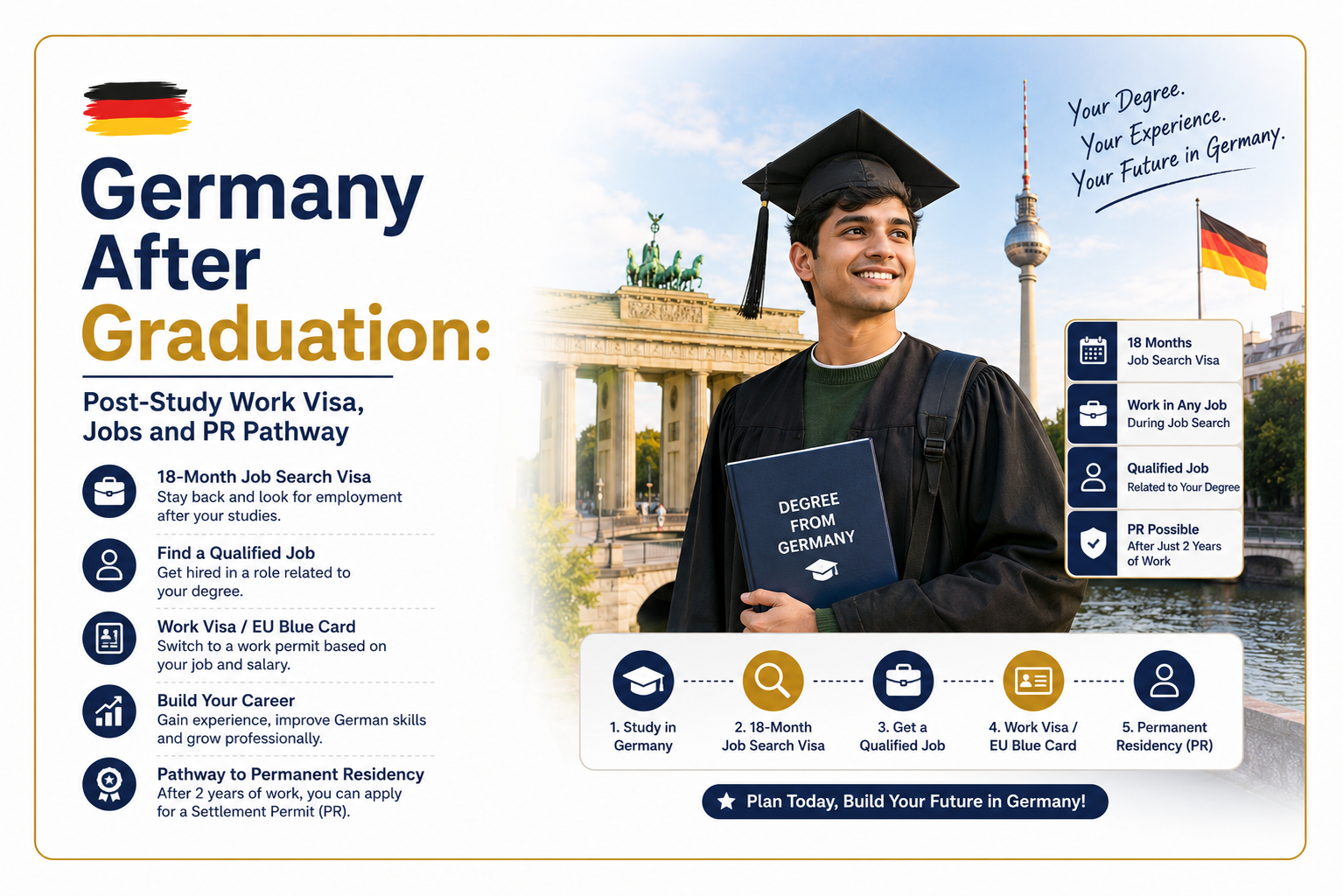
Germany Study → Job → PR: Simple Path
The general pathway can look like:
Study in Germany
↓
Complete your degree
↓
Up to 18-month job-search residence permit
↓
Find qualified employment
↓
Residence permit for skilled employment / EU Blue Card
↓
Build employment and meet residence requirements
↓
Potential settlement permit
The actual route depends on your qualifications, job, salary, residence status and other requirements.
Which Graduates May Have Better Opportunities?
Germany’s labour market currently has demand in several areas, particularly:
- Engineering
- IT
- Healthcare
- Sciences
- Manufacturing
- Transport
- Technical professions
The official German employment portal identifies engineering, IT, healthcare and other skilled occupations among important areas of demand.
However, demand changes over time and varies by region.
Therefore, students should research the labour market before selecting their degree.
The Biggest Mistake Students Make
Many students think:
“If I complete a Master’s in Germany, I will automatically get PR.”
That is incorrect.
A more realistic understanding is:
German Degree + Skills + Internship + Job + German Language + Relevant Residence Status + Meeting Legal Requirements
can create a pathway toward long-term residence.
How Can Students Improve Their Chances?
Start preparing for your career before graduation.
During Year 1
Focus on:
- Academic performance
- German A1/A2
- Technical skills
- Networking
During Year 2
Focus on:
- Internship
- Working student position
- German B1
- CV and LinkedIn
- Industry projects
Before Graduation
Start:
- Applying for jobs
- Building employer contacts
- Attending career fairs
- Improving German
- Preparing professional applications
Do not wait until the final month of your degree to start looking for work.
Final Advice
Germany can provide a strong pathway from education to employment, but students need to plan carefully for the transition.
The post-study period gives eligible graduates time to search for qualified employment, while Germany provides several residence routes for those who secure suitable employment. Students should therefore understand the Germany Student Visa Process and plan their study journey with their long-term career goals in mind.
Choosing the right university is equally important. Students can compare Public vs Private Universities in Germany and explore suitable institutions through the Germany University List.
For students planning a long-term future in Germany, the best strategy is to build more than just a degree:
Degree + German Language + Practical Experience + Industry Skills + Professional Network
That combination can significantly strengthen your career prospects and help you prepare for a successful transition from study to employment in Germany.