


Table of Contents
Germany is one of the most popular study destinations for international students, especially students looking for strong academic education and career opportunities in Europe.
But one question comes up again and again:
Should I choose a public university or a private university in Germany?
The answer is not simply “public is better” or “private is better.”
Both types of institutions can offer good programmes. The right choice depends on your course, budget, admission profile, university recognition, teaching language and career goals.
What Is a Public University in Germany?
Public universities are state-funded higher education institutions.
Germany has many internationally recognised public universities, universities of applied sciences and other state-recognised institutions.
Public universities are often attractive to international students because tuition fees can be relatively low compared with many other study destinations.
However, students should not assume that every public university in Germany is completely tuition-free.
Some programmes and some federal states can have tuition fees for certain international students. Students must check the current fee structure of their specific university and programme.
In addition to tuition, students normally need to pay a semester contribution.
What Is a Private University?
Private universities are funded differently from public universities and generally charge tuition fees.
The tuition cost can be significantly higher than at many public universities.
However, private universities may offer advantages such as:
- More specialised programmes
- Smaller class sizes
- Flexible intakes
- More English-taught programmes
- Industry-focused teaching
- Flexible admission options
- Strong career and business networks at some institutions
The quality can vary, so students should research the individual institution rather than choosing a university simply because it is private.
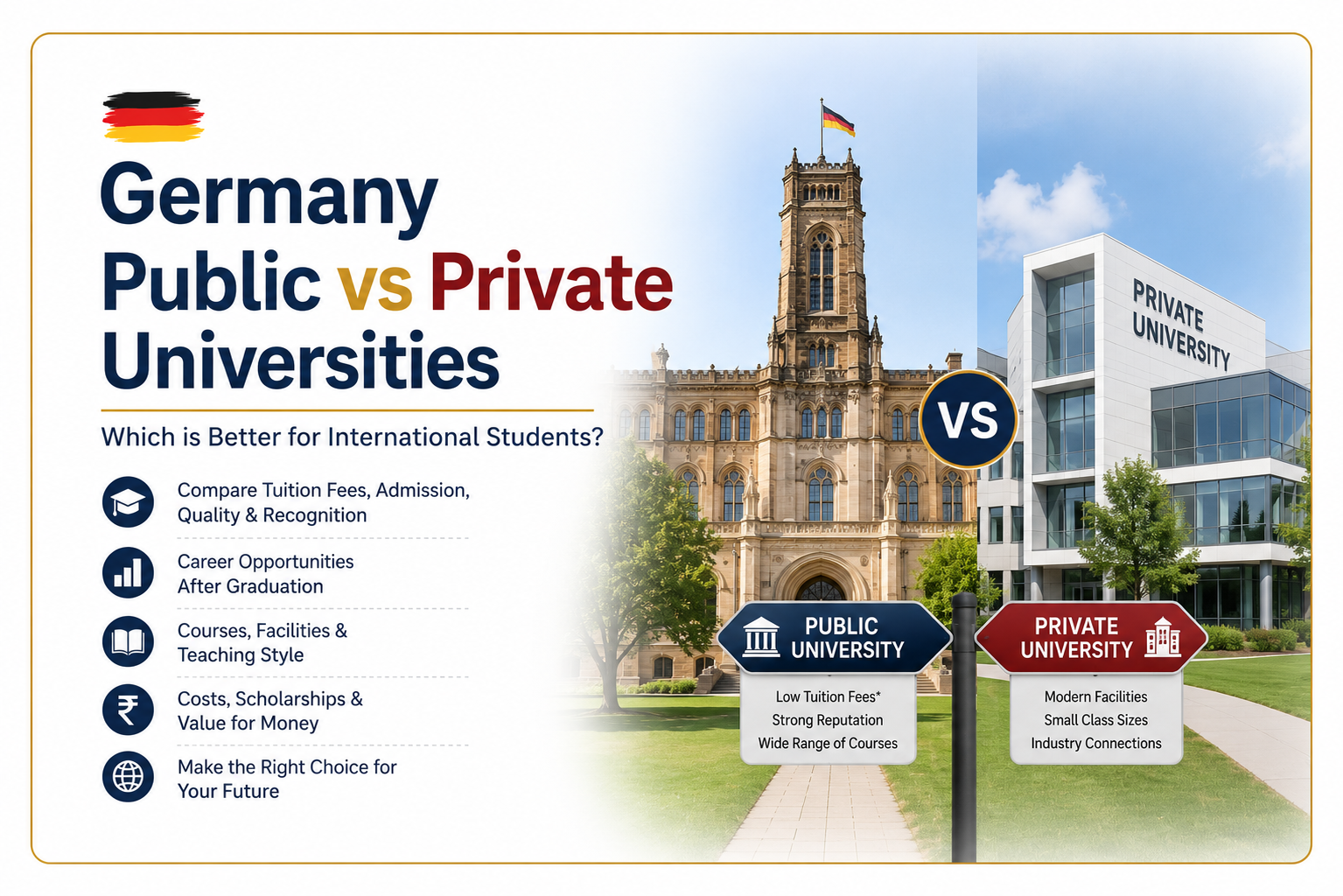
Public vs Private University: Quick Comparison
| Factor | Public University | Private University |
|---|---|---|
| Tuition | Often low, but varies | Usually higher |
| Semester contribution | Usually applicable | Depends on institution |
| Admission | Can be competitive | Often more flexible, depending on programme |
| English-taught programmes | Available | Often widely available |
| Class size | Can be larger | Often smaller |
| Practical learning | Depends on programme | Often strongly career-oriented |
| Reputation | Many globally recognised institutions | Depends heavily on institution |
| Career value | Strong when programme is relevant | Strong when institution/programme is recognised and industry-linked |
| Budget | Generally more affordable | Generally more expensive |
Does Public University Have More Value After Graduation?
Not automatically.
A student’s career outcome depends on much more than whether the university is public or private.
Employers may consider:
- Your degree
- Your technical skills
- Work experience
- Internships
- German-language ability
- University and programme
- Academic performance
- Projects
- Communication skills
- Industry knowledge
- Location
- Previous professional experience
For example, a student graduating from a recognised private university with strong practical experience may have better employment prospects than a student from a public university who has no internship or practical skills.
Similarly, studying at a famous public university does not automatically guarantee a job.
What About University Recognition?
This is one of the most important points.
Before paying tuition or accepting admission, students should check whether the institution and programme are appropriately recognised and whether the qualification will serve their intended career and immigration pathway.
Do not choose a university only because an education consultant, agent or social-media video says it is “best.”
Research the actual institution, programme curriculum, accreditation/recognition, graduate outcomes and career opportunities.
Which Is Better for Indian Students?
For students with a strong academic profile and a suitable programme available at a public university, a public university can be an excellent choice.
For students who need:
- More flexible admission options
- English-taught programmes
- Specific specialised courses
- Smaller classes
- Industry-oriented education
- Alternative intakes
a suitable private university can also be worth considering.
The important word is suitable.
The Best University Is Not Always the Cheapest University
Students should compare the complete picture:
University + Course + Cost + Recognition + Skills + Internship + Job Market
rather than looking only at tuition fees. A low-cost programme with weak career relevance may not be the best choice. Likewise, paying high private-university tuition does not automatically produce a higher salary.
Final Advice
Before selecting a German university, ask yourself five questions:
- Is the university and programme properly recognised?
- Is the course relevant to my previous education?
- What skills will I gain?
- What career opportunities exist after graduation?
- Can I realistically afford the total cost?
Germany offers opportunities through both public and private higher education. The right decision should be based on the quality and relevance of the specific programme, not simply the public-versus-private label.