

Table of Contents
Canada Study Permit Funds Increase 2026: New Proof of Funds Requirements for International Students
Published: September 4, 2026
Category: Canada Student Visa / Study in Canada
Canada has increased the amount of money international students must demonstrate when applying for a study permit.
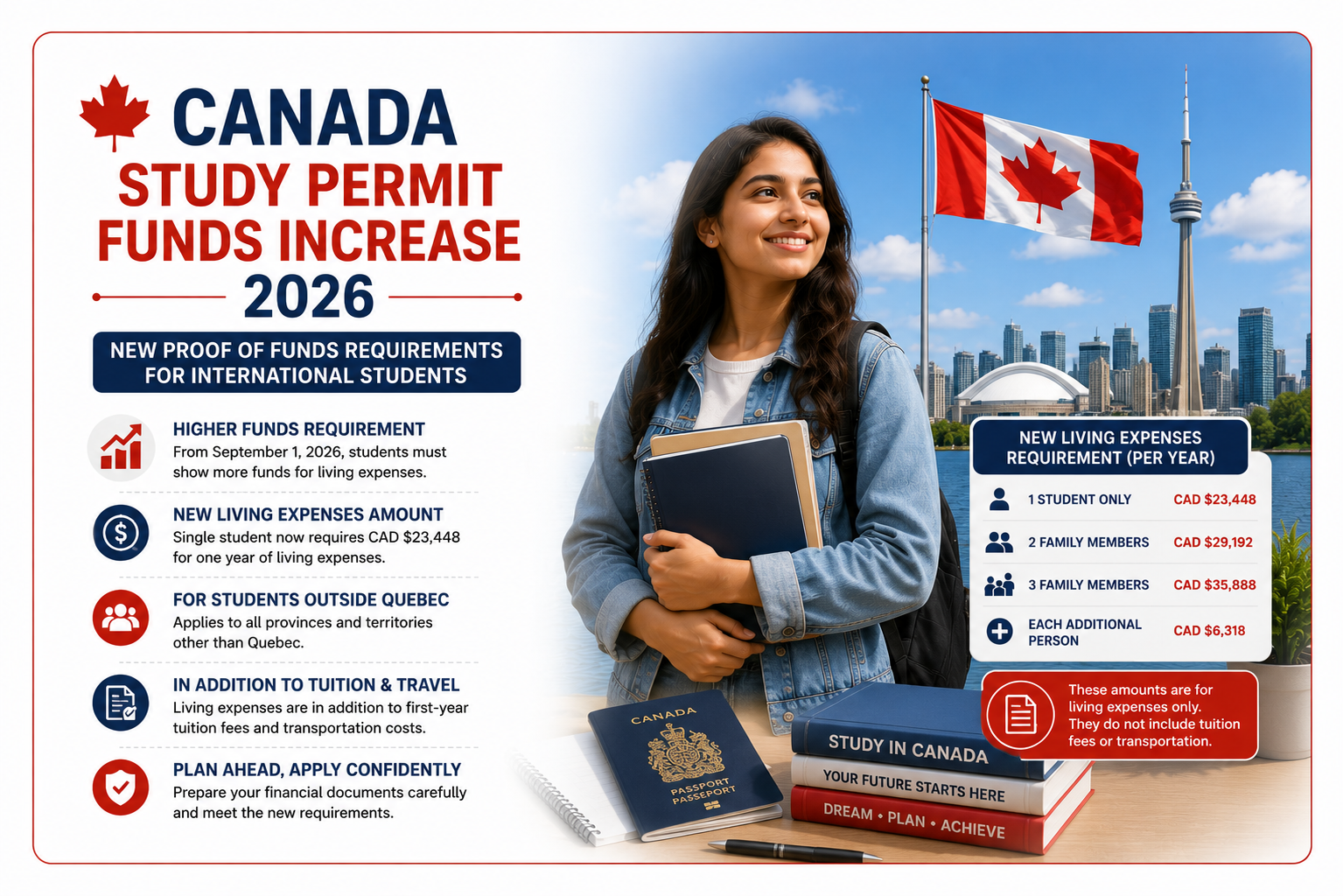
For study permit applications submitted on or after September 1, 2026, students planning to study in any Canadian province or territory other than Quebec must show higher funds for their living expenses.
The new financial requirement is important for international students because the amount required for living expenses is in addition to first-year tuition fees and transportation costs.
According to Immigration, Refugees and Citizenship Canada (IRCC), a single student with no accompanying family members must now demonstrate CAD $23,448 for one year of living expenses.
This update means students preparing a Canada study permit application should review their financial documentation carefully before submitting their application.
What Has Changed for Canada Study Permit Applicants in 2026?
The Canadian government adjusts study permit financial requirements periodically to reflect changes in living costs.
For applications submitted from September 1, 2026, the required living-expense amounts outside Quebec are:
| Family Members in Canada | Required Living Funds Per Year |
|---|---|
| 1 – Student only | CAD $23,448 |
| 2 | CAD $29,192 |
| 3 | CAD $35,888 |
| 4 | CAD $43,572 |
| 5 | CAD $49,419 |
| 6 | CAD $55,736 |
| 7 | CAD $62,054 |
| Each additional person | CAD $6,318 |
These amounts are for living expenses only. They do not include tuition fees or transportation to and from Canada.
Example: Single Student Applying for a Canada Study Permit
Suppose a student is planning to study in Ontario and has:
- First-year tuition: CAD $25,000
- Required living expenses: CAD $23,448
- Estimated transportation expenses: CAD $2,000
The student should plan to demonstrate financial capacity for approximately:
CAD $50,448
The actual amount required for transportation will depend on the student’s circumstances and travel costs.
Therefore, students should not interpret CAD $23,448 as the total amount required for a Canada study permit. It is the living-expense component of the financial requirement.
IRCC requires applicants to demonstrate sufficient funds for tuition, living expenses and transportation.
When Does the New Canada Proof of Funds Requirement Apply?
The new amounts apply to applications submitted on or after September 1, 2026.
IRCC’s official page states that applications submitted between January 1, 2025 and August 31, 2026 were subject to the previous financial amounts. Applications submitted from September 1, 2026 are assessed using the updated amounts.
This makes the timing of an application important for students preparing their financial documentation.
What Funds Must a Student Show?
Financial capacity for a Canadian study permit is broader than simply maintaining a particular bank balance.
IRCC expects students to demonstrate that they can pay for:
- First-year tuition fees
- Living expenses for themselves and accompanying family members
- Transportation to and from Canada
- The remaining cost of their studies if their program lasts longer than one year
For programs lasting more than one year, applicants should explain how they intend to finance the remainder of their education.
This means a student applying for a two-year diploma or degree should think beyond the first year and prepare a credible financial plan for the entire program.
What Documents Can Be Used as Proof of Funds?
IRCC accepts different forms of financial evidence depending on an applicant’s circumstances.
Common examples include:
1. Bank Statements
Students may use Canadian or foreign bank statements to demonstrate available funds.
IRCC currently indicates that bank statements can be used as evidence of financial resources and that documentation should demonstrate the source of funds.
For Indian students, this means maintaining clear and properly documented banking records is particularly important.
2. Education or Student Loan
An education loan from a recognized financial institution can be used as part of the financial evidence.
Students should provide appropriate loan documentation showing the approved amount and relevant terms.
3. Guaranteed Investment Certificate (GIC)
A GIC from a Canadian financial institution can also be used as financial evidence.
However, students should assess their complete financial requirement rather than assuming that a GIC by itself satisfies every part of the study permit financial requirement.
4. Tuition and Housing Already Paid
If tuition or eligible housing expenses have already been paid, students can provide receipts or official confirmation from the educational institution.
However, paying tuition does not eliminate the requirement to demonstrate sufficient funds for living expenses and transportation.
5. Scholarship or Funding
Students receiving scholarships or other recognized educational funding can provide official documentation confirming the amount and duration of the financial support.
If the scholarship covers only tuition, additional evidence may be required for living expenses and transportation.
6. Financial Support From Parents or Another Sponsor
A student’s education may be funded by parents, relatives or another financial supporter.
In such situations, the application should establish:
- The relationship between the student and financial supporter
- The sponsor’s employment or occupation
- The sponsor’s financial capacity
- The amount of support being provided
- Evidence supporting the source of the money
IRCC specifically lists documentation concerning the relationship, employment/occupation and financial support as examples of evidence that may be used.
Source of Funds Is Becoming More Important
Having the required amount of money in a bank account is not necessarily the end of the financial assessment.
IRCC’s current guidance says officers assess both the amount of funds and their source, and applicants should provide documentation demonstrating the source of income represented in their financial records.
This is especially important where an account shows:
- Large recent deposits
- Unexplained transfers
- Recently borrowed money
- Transfers between multiple accounts
- Sale of assets
- Business income
- Property-related income
- Financial support from another person
Students should therefore focus on documenting the financial history and source of funds, rather than simply arranging a large balance shortly before submitting an application.
How Indian Students Can Prepare Their Financial Documents
For students applying from India, a well-organized financial file can make the application easier to understand.
Depending on the individual circumstances, students may consider preparing:
- Recent bank statements
- Education loan sanction documents, where applicable
- Fixed deposit documentation, where relevant
- Income evidence of parents or sponsors
- Employment letters
- Salary slips
- Income-tax documentation
- Business registration and business income evidence, where applicable
- Property or rental income documentation, where relevant
- Scholarship letters
- Tuition payment receipts
- GIC documentation, where applicable
- A clear explanation for significant transactions
The objective should be to demonstrate a credible and traceable source of financial support.
What If a Student Has a Large Recent Bank Deposit?
A large recent deposit can raise questions if its origin is not properly documented.
For example, if a student’s account normally contains CAD-equivalent funds of a much lower amount and a substantial deposit appears shortly before the application, the applicant should be prepared to explain where the money came from.
Depending on the circumstances, supporting evidence could include documentation relating to:
- An education loan
- Sale of an asset
- Transfer from a parent
- Maturity of an investment
- Business income
- Other legitimate sources of funds
There is no single document that works for every applicant. The evidence should correspond to the actual source of the money.
What About Students Applying for Programs Longer Than One Year?
Meeting the first-year financial requirement is essential, but students enrolled in longer programs should also explain how they intend to finance the remaining period.
For example, a student applying for a two-year program could explain a combination of:
- Family income
- Education loan
- Savings
- Scholarship
- Employment income of parents
- Other legitimate financial resources
IRCC specifically states that applicants whose program lasts longer than one year must explain how they intend to pay for the remainder of their studies.
Canada Study Permit Funds for Students With Family Members
The financial requirement increases when family members accompany the student.
For example:
- Student alone: CAD $23,448
- Student + 1 family member: CAD $29,192
- Student + 2 family members: CAD $35,888
- Student + 3 family members: CAD $43,572
The family-size calculation includes the applicant and family members accompanying them to Canada.
Students bringing a spouse or children should therefore calculate their financial requirement before finalizing their study permit documentation.
What About Quebec?
Quebec has its own financial requirements and immigration procedures.
Students planning to study in Quebec should not simply apply the federal non-Quebec figures to their situation. Quebec applicants generally need to satisfy Quebec’s requirements, including the applicable Quebec immigration documentation, before proceeding with the federal study permit process.
Therefore, students should check the current Quebec requirements separately before preparing their financial file.
Is CAD $23,448 Enough for a Canada Study Permit?
No.
This is one of the most important points students should understand.
For a single applicant outside Quebec, CAD $23,448 represents the annual living-expense requirement, not the total amount needed for the complete study permit application.
The student must also account for:
First-year tuition + living expenses + transportation
For example:
CAD $25,000 tuition
- CAD $23,448 living expenses
- transportation costs
= overall financial requirement
The exact total will vary according to the student’s university or college, tuition fees, destination and travel costs.
Does Paying Tuition Remove the Proof-of-Funds Requirement?
No.
Even when a student has already paid tuition, they must still demonstrate that they have enough money for their remaining financial obligations, including living expenses and transportation.
IRCC specifically notes that proof of paid tuition should be accompanied by evidence demonstrating sufficient funds for living and travel costs.
Why Financial Planning Matters More Than Ever
Canada’s study permit assessment is not based on one document or one bank balance.
An applicant needs to demonstrate that their overall application makes sense.
Financial documentation should be consistent with:
- Educational background
- Proposed program
- Tuition costs
- Family circumstances
- Sponsor’s income
- Banking history
- Source of funds
- Future study expenses
A strong financial file can help an officer understand how the student intends to finance their education without relying on unauthorized or uncertain sources of income.
IRCC’s study permit eligibility requirements also include demonstrating sufficient funds and convincing the officer that the applicant will leave Canada when their study permit expires, subject to the circumstances of their application.
Canada Study Permit 2026: Financial Checklist
Before submitting a study permit application, students should review the following:
Financial Requirement Checklist
☑ Calculate the first-year tuition fees
☑ Calculate the applicable living-expense requirement
☑ Include transportation costs
☑ Consider accompanying family members
☑ Prepare recent bank statements
☑ Document the source of significant deposits
☑ Prepare sponsor income documents, if applicable
☑ Include education loan documents, if applicable
☑ Include scholarship documents, if applicable
☑ Include tuition payment receipts, if applicable
☑ Prepare a financial plan for subsequent years
☑ Check country-specific visa office instructions
☑ Make sure financial documents are consistent with the overall application
Important Advice for Students Applying From India
The increase in Canada’s proof-of-funds requirement does not mean that simply showing the new minimum amount guarantees study permit approval.
Financial capacity is one part of the overall assessment.
Students should also ensure that their application clearly presents their:
- Academic background
- Choice of institution
- Choice of program
- Career objectives
- Study plan
- Financial circumstances
- Immigration history, where applicable
- Ties and overall temporary-resident circumstances
IRCC can refuse a study permit application for several reasons, including insufficient financial evidence or failure to satisfy the officer that the applicant meets the requirements of the study permit.
Need Help With Your Canada Study Permit Application?
Preparing the correct financial documents is an important part of a Canada study permit application, particularly when family funds, education loans, business income or large transactions are involved.
If you are planning to study in Canada from Surat or elsewhere in Gujarat, Novasask Education and Immigration can help you understand the documentation required for your individual profile, including course selection, admission guidance, financial documentation and study permit application preparation.
Learn more about our Canada Student Visa services:
https://www.novasask.com/canada-student-visa-consultant-in-surat.html
Final Takeaway
From September 1, 2026, a single study permit applicant planning to study outside Quebec must demonstrate CAD $23,448 for one year of living expenses.
But this amount is only one component of the financial requirement.
Students should also demonstrate funds for first-year tuition and transportation, while applicants enrolled in programs longer than one year should explain how they will finance the remainder of their studies.
Most importantly, students should ensure that their financial documents tell a clear and credible story about where their money comes from and how their education will be funded.
For the latest requirements, applicants should always verify the information on the official Government of Canada/IRCC website before submitting their application.