
Updated: 16 October 2026
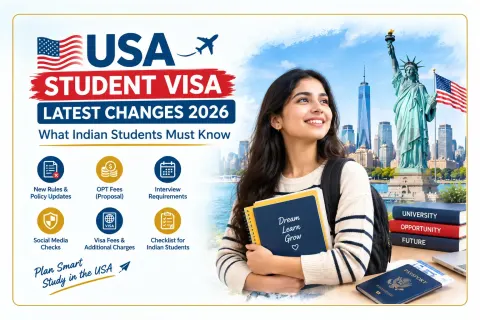
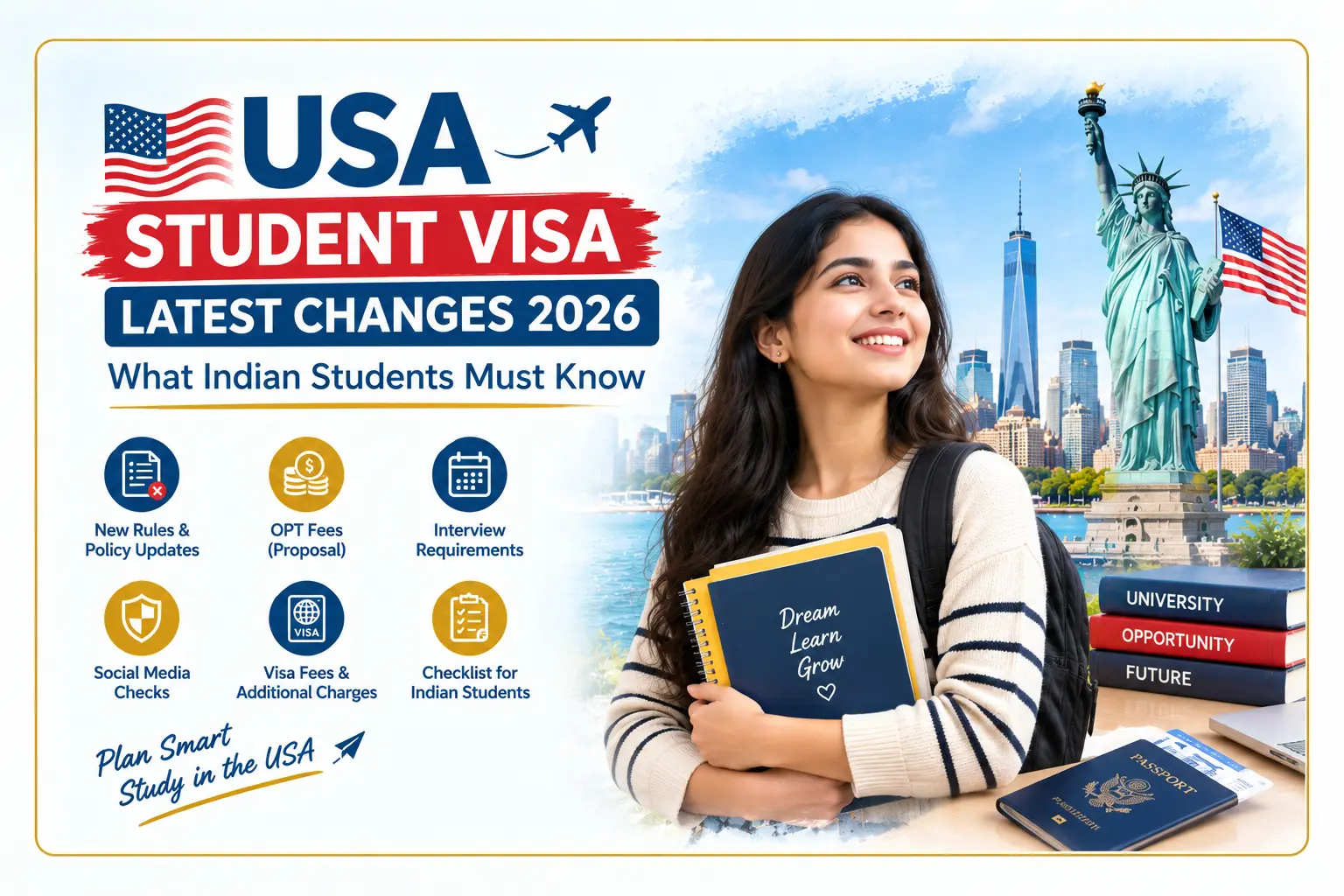
USA student visa changes 2026
Planning to study in the United States? The rules for the USA student visa (F-1) have changed a lot over the last year, and some new proposals could affect your costs and work options after graduation. Some changes are already in force, some have been blocked by a court, and some are only proposals. This guide explains each one in simple words, so you know exactly what applies to you today.
 Quick summary: USA student visa changes at a glance
| Change | Status (as of 16 October 2026) | What it means for you |
|---|---|---|
| Fixed 4-year admission period (end of “duration of status”) | Blocked by a federal court | You are still admitted for “duration of status” for now |
| New OPT fees of $70,000 + $30,000 | Only a proposal | No new OPT fee is charged today |
| Interview in your home country | In force since September 2025 | Indian students must interview in India |
| In-person interview for F-1 | In force since September 2025 | Plan for an interview; book your slot early |
| Social media checks | In force since June 2025 | Your social media accounts must be public |
| $250 visa integrity fee | Law passed; collection varies by embassy | Check the official US Mission India fee page |
1. The “4-year limit” rule: blocked by a court for now
On 17 July 2026, the US Department of Homeland Security (DHS) published a final rule to end “duration of status” (D/S) for F-1 students. Today, F-1 students can stay in the US as long as they keep studying full-time and follow the visa rules. The new rule would have replaced this with a fixed end date: the program end date on your I-20, or a maximum of four years, whichever is shorter.
The rule would also have:
- reduced the grace period after your program ends from 60 days to 30 days;
- required students who need more time to apply to USCIS for an extension of stay, with biometrics and fees;
- limited school transfers and changes of program during the first academic year for most undergraduate students.
The rule was due to start on 15 September 2026. On 14 September 2026, a federal court in Massachusetts paused it, so DHS cannot apply it while the court case continues. The government is expected to appeal.
What this means for you: for now, F-1 students are still admitted for “duration of status”. But the court's decision is temporary and the situation could change quickly. Always check the I-94 record you receive when you enter the US, and follow updates from your university's international student office (your DSO).
2. Proposed new OPT fees: up to $100,000 (not in effect)
On 8 October 2026, DHS published a proposed rule that would charge large new fees for Optional Practical Training (OPT), the work permission many F-1 students use after graduation:
- $70,000 when the university first recommends a student for OPT;
- $30,000 for each later recommendation, including the 24-month STEM OPT extension.
The fee would be paid by the university, but universities would be allowed to pass the cost on to students or employers. Public comments are open until 9 November 2026.
Important: this is only a proposal. No new OPT fee is being charged today. If it becomes final, it can take effect only after it is published as a final rule. Keep an eye on this if OPT is a key part of your study plan.
3. Visa interview must be in your home country
Since 6 September 2025, the US State Department expects visa applicants, including F-1 students, to apply in their country of nationality or legal residence. For Indian students, this means booking your interview at a US Embassy or Consulate in India. Booking a slot in another country to get an earlier date is no longer a workaround, and visa fees cannot be moved to a different location.
4. In-person interview is required for F-1 visas
From 2 September 2025, the interview waiver (“dropbox”) facility was withdrawn for most visa types, including F-1 student visas. Almost every student now needs an in-person interview. Because of this, appointment waiting times in India can be long, so apply as soon as you receive your I-20.
5. Social media checks for all student visa applicants
Since June 2025, the US checks the online presence of all F, M and J visa applicants. Applicants are asked to set their social media accounts to “public” so they can be reviewed.
- List all your social media handles correctly on the DS-160 form.
- Make sure your education, work and travel details online match your application.
- Do not delete accounts just before applying; this can raise questions.
6. The $250 visa integrity fee
A US law signed in July 2025 created a new visa integrity fee of $250 for most non-immigrant visas, payable when the visa is issued, with a possible refund if you follow all visa rules. Collection has started at some embassies but not at others, and reports differ for India. Before paying anything, check the official US Mission India fee page.
The main fees that every F-1 applicant pays today are the visa application (MRV) fee of $185 and the SEVIS I-901 fee of $350.
7. Working after graduation: the H-1B fee
In September 2025, the US introduced a $100,000 fee on certain new H-1B petitions. According to USCIS guidance, this fee generally does not apply to F-1 students (including those on OPT or STEM OPT) who change to H-1B status while staying inside the US. Leaving the US during the process can change this, so speak to an immigration attorney before you travel.
Checklist for Indian students applying for a USA student visa
- Apply to SEVP-certified universities and get your Form I-20.
- Pay the SEVIS I-901 fee ($350) and keep the receipt.
- Fill the DS-160 form carefully, including all social media handles.
- Set your social media accounts to public.
- Pay the visa fee ($185) and book your interview in India as early as possible.
- Prepare strong financial documents and proof of ties to India.
- Practise the visa interview: be clear about your course, university, funding and plans after study.
- Keep following updates from your university, as rules may change before you travel.
For the full list of documents, read our guide: What Are the Requirements for US Student Visa for Indian Citizens?
Is the USA still a good choice for Indian students?
Yes. The US still has many of the world's top universities, strong STEM programs and good career opportunities. The difference now is that you need more careful planning: apply early, prepare your documents properly, keep your profile consistent, and follow rule changes closely. The changes mostly reward genuine, well-prepared students.
How Novasask can help
At Novasask Education and Immigration, Surat, our counsellors help you choose the right US university, prepare your I-20 documents, fill your DS-160 correctly and practise for your visa interview with mock sessions. We also offer coaching for the English tests US universities ask for. Contact us or call (0261) 3175370 to plan your USA study journey.
Sources
- Federal Register: Fixed Time Period of Admission final rule (17 July 2026)
- Study in the States (DHS): final rule announcement
- Fragomen: court postpones the duration of status rule (14 September 2026)
- Ogletree: DHS proposes new OPT fees (8 October 2026)
- US Department of State: Student Visa
- US Embassy & Consulates in India: Visas
Disclaimer: This article is for general information only and is not legal advice. US visa rules change often; please check the official US government websites or speak to our counsellors before making decisions.

Leave a Comment